
An overview of the benefits of Neurological Music Therapy by our founder Claire Ingham.
When damage occurs to certain areas of the brain such as the basal ganglia and the cerebellum, the brain loses its ability to internally generate smooth, automatic movement sequences it can cause motor problems such as bradykinesia (slowness), rigidity, loss of limb coordination, timing, balance, spatial accuracy, gait instability and speech problems.
This can be seen in dyskinetic/ataxic Cerebral Palsy, Parkinson’s Disease and some Strokes.
Neurologic Music Therapy (NMT) serves as a profound rehabilitation tool by bypassing damaged areas and routing movement signals through alternative, intact brain networks.
Here is exactly how music therapy accomplishes this to meet physiotherapy goals…
Bypassing the Defective "Internal Clock"
The basal ganglia normally act as the brain’s internal metronome, pacing everyday movements like walking or reaching. When it is damaged, movements become unpredictable, random, or completely frozen.
The Bypass Mechanism:
Instead of forcing the brain to rely on its broken internal clock, Rhythmic Auditory Stimulation (RAS) introduces a strong, predictable external clock.
Rhythmic Entrainment:
Using music, the human, auditory system has a direct, hardwired link to the motor system. When a person hears a steady, predictable pulse, their motor neurons instinctively fire in sync with that beat. This process acts as an external timing mechanism, providing the brain with a “predictive blueprint” to execute movements smoothly.
The Alternative Pathway:
The auditory rhythm enters through the ears and travels straight to the cerebellum and the lateral premotor cortex. This cerebellar-thalamocortical motor network is perfectly intact and takes over the job of planning and executing the movement. And when there is damage to the cerebellum, external musical rhythms can activate parallel motor regions, such as the basal ganglia and the supplementary motor area. This helps the brain map out and synchronise movement through alternative networks.
Neuroplasticity:
Engaging in structured, music-driven exercises promotes the growth of new neural connections, assisting the brain in re-learning motor functions and stabilising muscle tension.
Specific Movement Improvements
Clinical evidence and music-based rehabilitation protocols focus on several targeted areas of physical function:
Gait and Balance: Rhythmic Auditory Stimulation (RAS):
A technique utilising strong, metronomic beats or military marches helps smooth out irregular, shuffling, or hesitant walking patterns. It improves stride length, walking velocity, and overall symmetry, which directly reduces the risk of falls.
The precise pulse of a musical beat automatically reorganises firing patterns in the motor cortex. When a patient listens to a steady rhythm, the auditory system calculates exactly when the next beat will land. It sends “pre-activation” signals down the spinal cord to the muscle groups before the movement even happens.
Muscles automatically prime, relax, and contract in perfect timing with the beat. This reduces rigid muscle resistance, making passive and active physical stretching exercises much smoother and longer-lasting.
Limb Coordination:
Music therapists use percussive instruments like drums to provide explicit visual and auditory targets. Reaching, stretching, and tapping to a beat assists patients in controlling erratic hand and arm movements.
Partnered Dance and Movement:
Programs incorporating dance-based therapies allow patients to work on core strength, postural stability, and weight shifting. Studies show that structured partnered dancing significantly enhances functional mobility and balance.
Speech and Swallowing:
Because ataxia affects the coordination of vocal and respiratory muscles, therapeutic singing exercises are used to improve breathing control, articulation, and vocal inflexion.
Rewiring the Brain’s Reward System (Dopamine Depletion)
The basal ganglia, specifically the substantia nigra are heavily reliant on dopamine, the chemical messenger responsible for motor learning and motivation.
Neurochemical Stimulation:
Anticipating and listening to highly structural, patient-preferred music stimulates the limbic system, triggering a natural release of dopamine in the remaining neural networks.
Higher dopamine levels promote neuroplasticity, helping the brain permanently cement the alternative pathways it is using to walk, balance, and move.
Important Considerations and Challenges
- While music-based therapy offers distinct advantages, its effectiveness can vary.
- The cognitive effort required to process a complex melody while trying to move can occasionally cause a “dual-task” overload.
- If a piece of music is too fast, complex, or lacks a prominent beat, it can paradoxically increase instability and make walking more difficult.
- For this reason, interventions are most effective when guided by a certified therapist. A therapist can customize the tempo, adjust the rhythmic emphasis, and seamlessly match the music to an individual’s natural movement speed to optimise recovery.
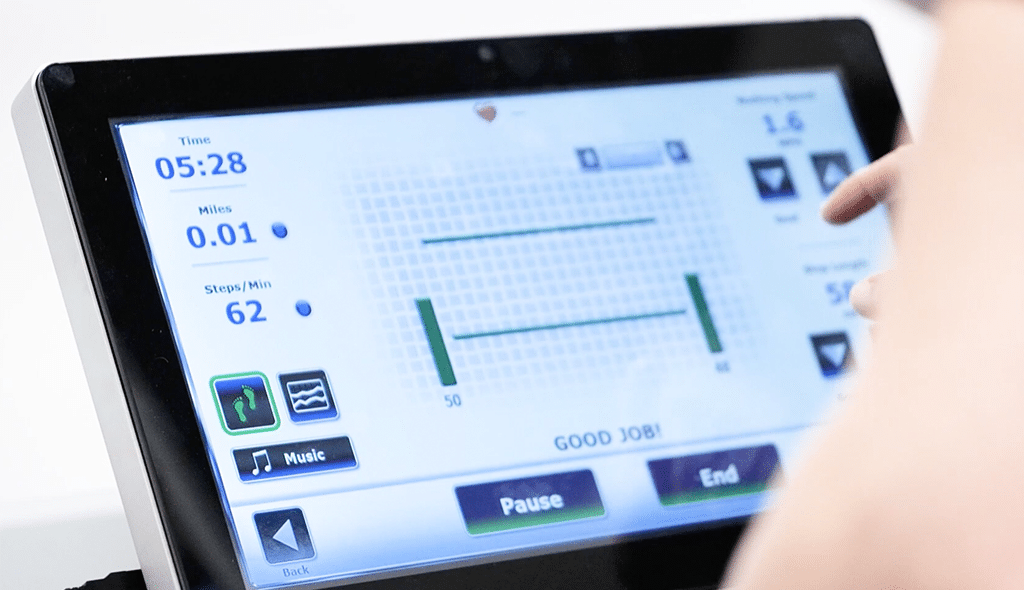
Biodex Gait Trainer
In clinic, using our Biodex gait trainer with our unweighting hoist automatically sets a client’s steps per minute range based on their gender, age, height and weight.
Together we can choose which type of music to use to practice gait training.
Clients get real time audio and visual feedback of their gait pattern which we can save and review against future sessions.
We Can Help
We are a team of highly experienced paediatric and adult treating physiotherapists across the North West of England. We are all HCPC registered and members of the Chartered Society of Physiotherapists.
With a wealth of knowledge and skills in paediatric and adult rehabilitation, you know you’re in safe hands.
If you or your child would benefit from Music Therapy treatment, we would love to help.
You can contact us for a free telephone consultation and to find out more about our cutting-edge services. Please get in touch below.